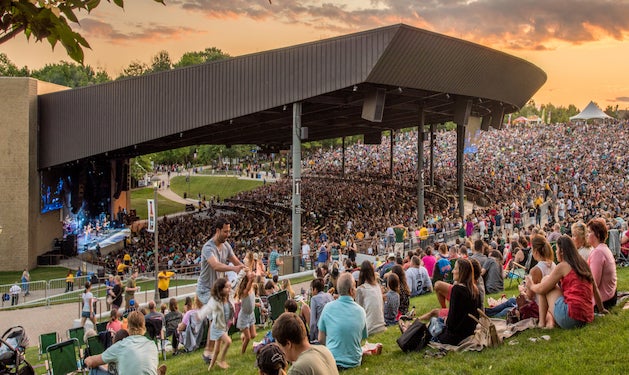
2024 Buildfest
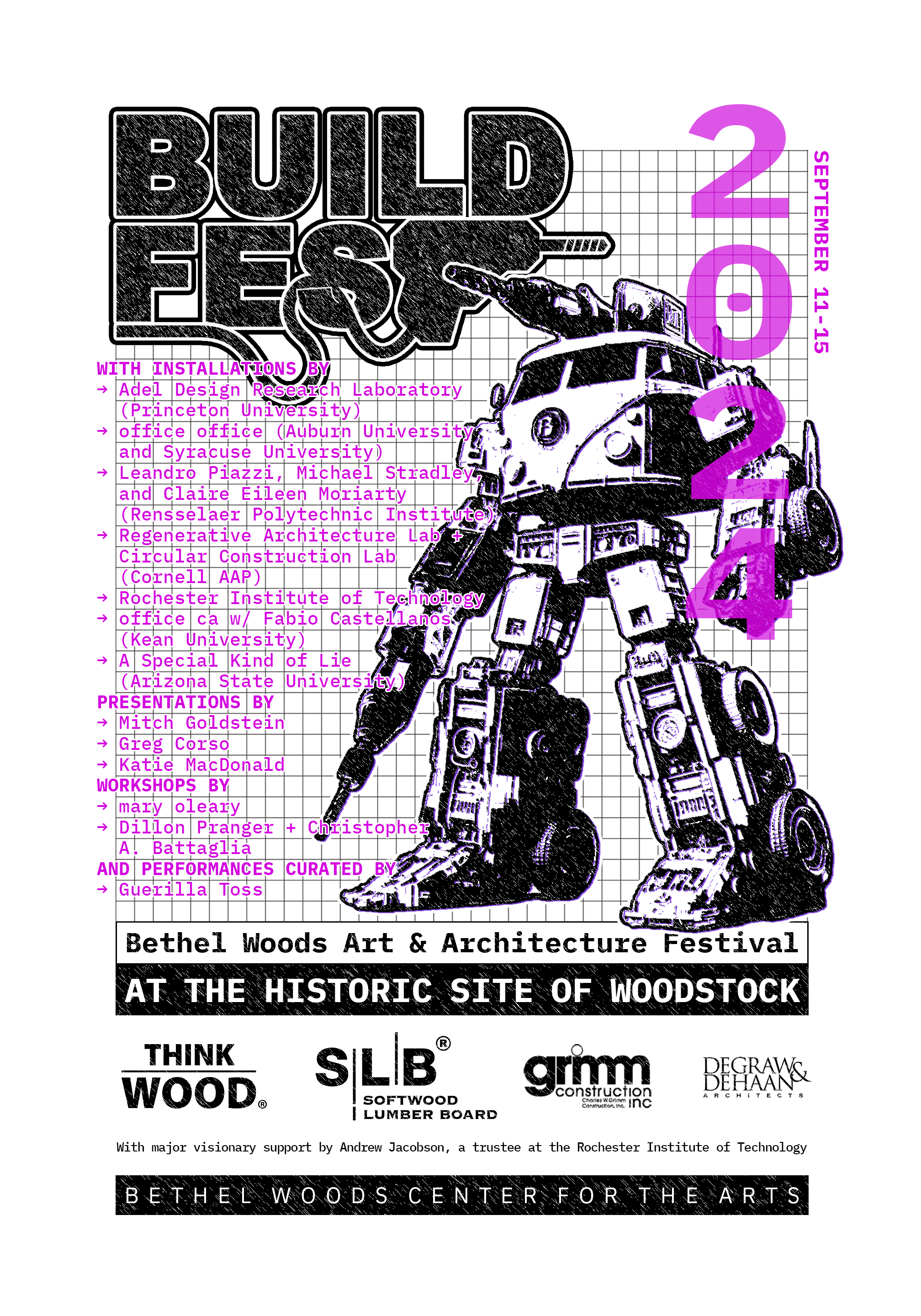
BuildFest: Build Community, Build Creatively, Build Fest
September 11-15, 2024
BuildFest marks the third year of the Bethel Woods Art & Architecture Festival and begins a multi-year project to merge digital and analog fabrication pedagogies with creative notions of function and play, focusing on flexibility and adaptation.
Candidates were asked to (1) take a stance on BUILDing in the 21st century and draw a line in the silica-rich sand that will one day get processed into their computer chips: Do you reject technology or embrace it—to what extent? And (2) detail how this stance generates a flexible (and physical) FESTivity for the digital epoch: how does the installation function in the context of a modern music festival—how can it adapt over three years?
This event was made possible by generous support from Think Wood, a program funded by the Softwood Lumber Board, Charles W. Grimm Construction, Inc, DeGraw and DeHaan Architects and Andrew Jacobson, a trustee at the Rochester Institute of Technology.
2024 Projects
Timberlyn
Project Name: Timberlyn
Project Leaders: Arash Adel (Faculty at Princeton University, Director Adel Design Research Laboratory).
Project Team: Ruxin Xie (Research Associate at Princeton University), Daniel Ruan (PHD Student at Princeton University), Zoe King Man Cheung (Student at Princeton University), Zhuofan Ma (Student at Princeton University). Autumn Siedlik (Student at Kean University), Carlos Lantigua (Student at Kean University), Rimervi Mendez Vasquez (Student at Kean University).
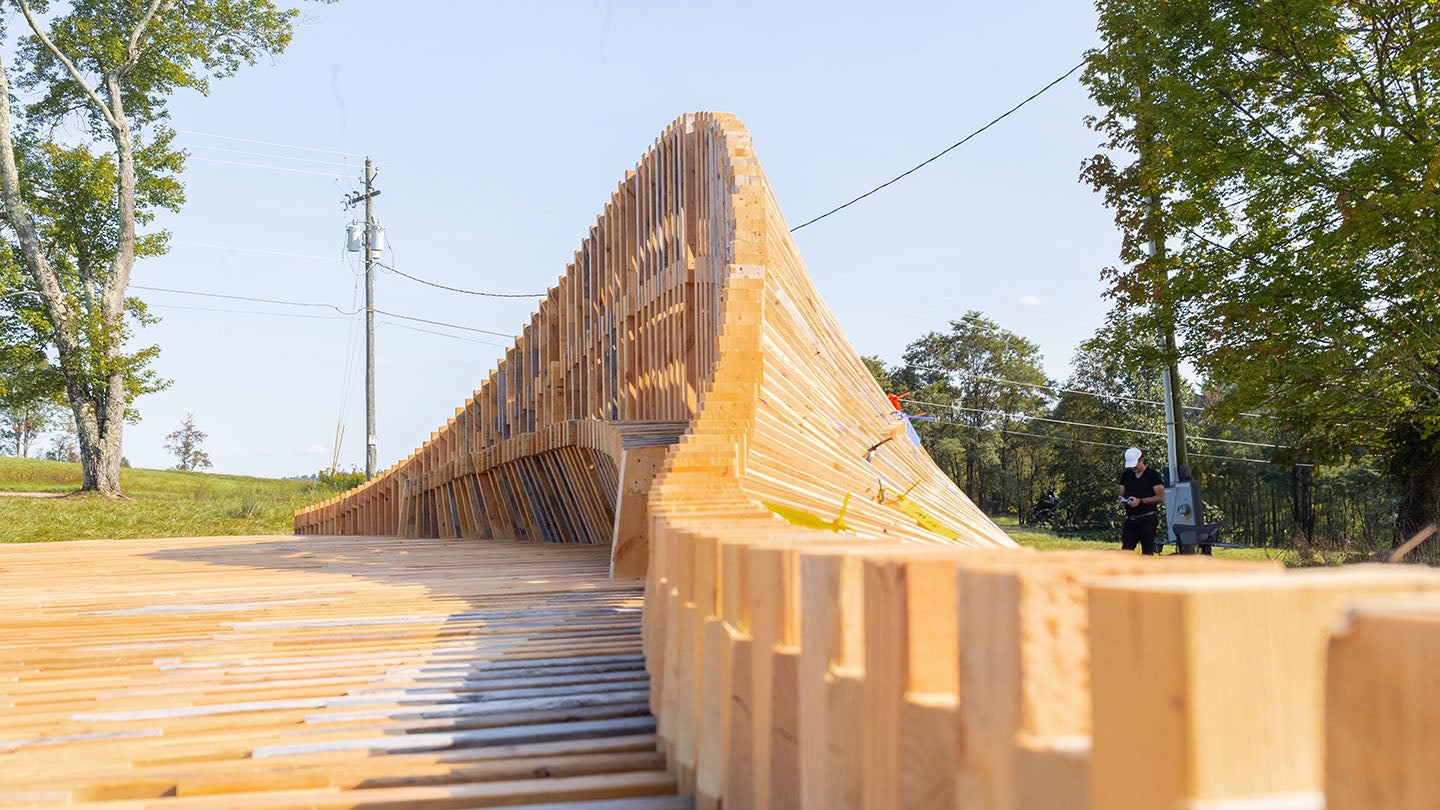
Project Description: Timberlyn is inspired by the historic spirit of Woodstock and epitomizes the synergy between human ingenuity and robotic precision. Crafted from the collaboration between humans and robots, this eco-conscious stage offers versatility, accommodating music performances and community events alike. The project utilizes state-of-the-art research in human-robot collaborative construction (HRCC), leveraging sustainable practices to design and fabricate a versatile structure from reclaimed dimensional lumber. In the HRCC process, humans and robots combine their respective advantages – the dexterity and decision-making capabilities of humans and the precision and efficiency of robots – in a shared assembly environment. The assembly workflow is enhanced through real-time perception feedback and adaptive control optimization, enabling waste minimization for bespoke construction and advancing current practices toward sustainable automation.
Curtain Call
Project Name: Curtain Call
Project Leaders: Cait McCarthy (Faculty at Auburn University, cofounder Office Office), Jordan Young (Faculty at Auburn University, cofounder Office Office).
Project Team: Lawson Spencer (Faculty at Cornell University), Maddie Brockman (Student at Auburn University), Patrick Fair (Student at Auburn University), Cayden Brown (Student at Auburn University), Ellie Marie Lambert (Student at Auburn University), Micah Betz (Student at Auburn University), Sam Glenn (Student at Auburn University), Emily Herr (Student at Syracuse University), Gretchen Hundertmark (Student at Syracuse University), Miles Smith (Student at Syracuse University), Sanskruti Kakadiya (Student at Syracuse University). AFO (Graduate of Cornell University).
Project Description: Curtain Call investigates the use of semi-automated construction methods to test the formal, spatial, and structural capacity of light wood framing. Semi-automated construction is a hybrid method that emphasizes human-robot collaboration. Rather than robotically automating the process entirely, this method allows human participants at all skill levels to easily engage in the construction process. Ultimately, this project considers alternate approaches that expand conventional modes of labor relative to the design, fabrication, and construction process. More than just a shade structure, the project provides a highly flexible “stage” that allows for a wide range of programming. It can accommodate informal, impromptu activities such as lounging, picnicking, or reading, or organized festival activities such as movie nights, lectures, pop-ups, and performances of all kinds.
Rise, Repeat
Project Name: Rise, Repeat
Project Leaders: Leandro Piazzi (Faculty at Rensselaer Polytechnic Institute), Michael Stradley (Faculty at Georgia Tech), Claire Eileen Moriarty (Faculty at Rensselaer Polytechnic Institute).
Project Team: Katie Soule (professional), Owen Lawler (Professional), Preston Kwok (Student at Rensselaer Polytechnic Institute), Zonglin Li (Student at Rensselaer Polytechnic Institute), Eric Diaz (Student at Rensselaer Polytechnic Institute), Emily Zheng (Student at Rensselaer Polytechnic Institute), Eben Negro (Student at Rensselaer Polytechnic Institute), Camilla Dominguez (Student at Rensselaer Polytechnic Institute), Isabel Montes (Student at Rensselaer Polytechnic Institute), Marcy Sushynski (Student at Rensselaer Polytechnic Institute), Chantal Celis (Student at Rensselaer Polytechnic Institute), Gunnar Thuss (Student at Rensselaer Polytechnic Institute), Isaiah Mercer (Student at Rensselaer Polytechnic Institute).
Project Description: The pavilion makes use of three off-the-shelf elements commonplace in everyday American domestic construction: (1) pressure-treated, pine stair stringers, (2) precast concrete deck footings, and (3) stainless-steel, star-drive deck screws. The repetition of uniform, pre-fabricated elements allows for an economical budget and ease/speed of assembly in the field. Stringer elements are joined mechanically with screws, without the need to cut or modify the elements and without using adhesives or coatings. This light-touch construction method allows for a strategy of disassembly and re-use, considering the full life cycle of the pavilion’s materials. After the three-year installation at Bethel Woods, the pavilion can be dismantled and relocated to another site or dismantled and donated to community building organizations in the area to be re-used as gently-used stair stringers in conventional construction. In this way, the project serves as a modest testing ground for a reusable, circular approach to architecture and its materials.
MycoShell
Project Name: MycoShell
Project Leaders: Marta H. Wisniewska (Faculty at Cornell University, Director Regenerative Architecture Lab), Felix Heisel (Faculty at Cornell University, Director Circular Construction Lab).
Project Team: Andrew Boghossian (Faculty at Cornell University, Research Associate Circular Construction Lab). Brenda Bai, Lauren Franco, Natasha Becker, Matthew Glaysher, Marina Rosolem, Jeeya Savani, Idil Derman, Eavan Flanagan, Edozie Onumonu, Jasper Owe (All Students at Cornell University).
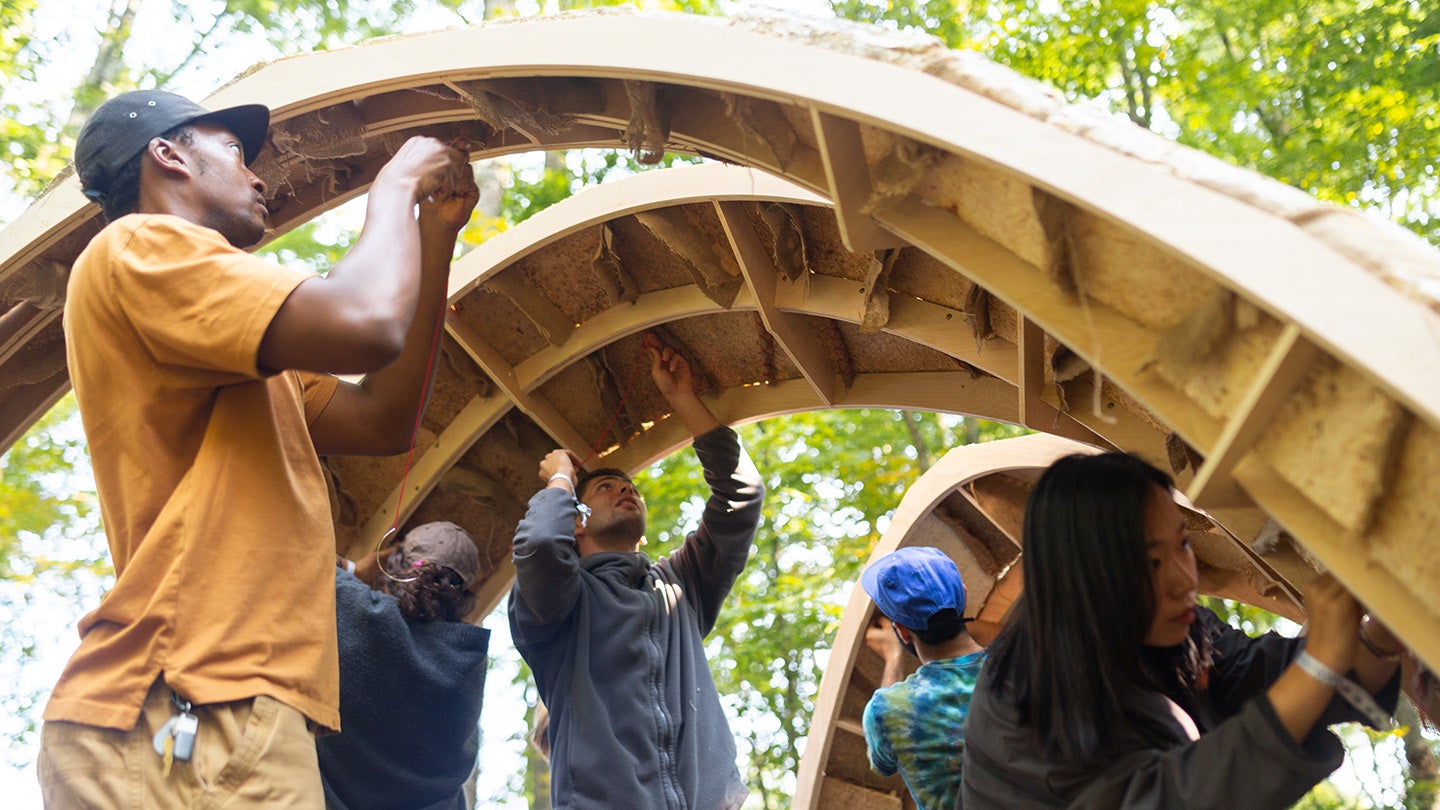
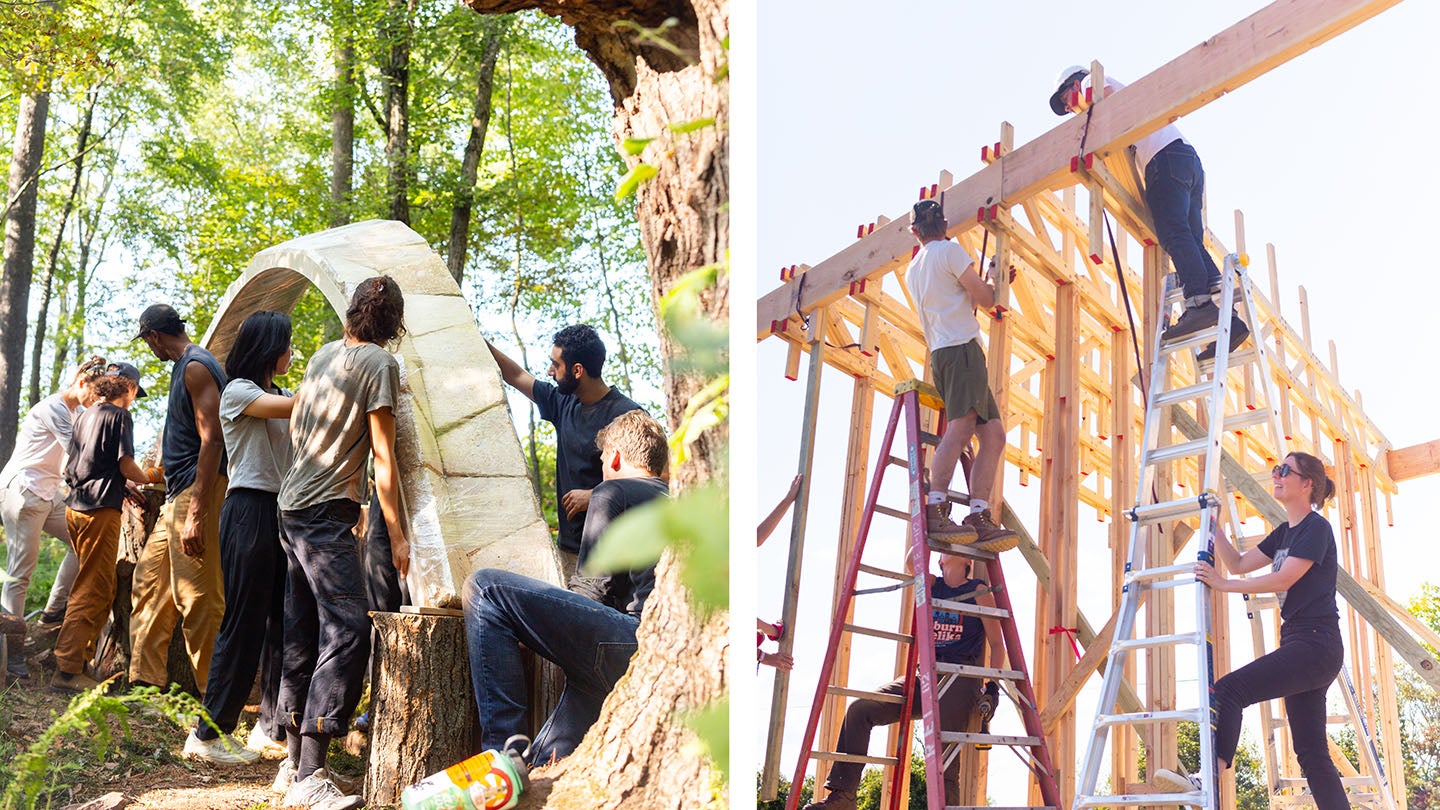
Project Description: MycoShell is an installation that exhibits the potential of biological self-growing and adaptive building materials toward a collaborative future of the digital and the analog. MycoShell is constructed of structural mycelium-bound composite panels that have been grown from a local fungal strain of the Ganoderma family on regional agricultural byproducts of corn and hemp. The result is a biobased, carbon-negative, and fully circular building component with structural capacities. MycoShell engages these mycelium-bound panels to form a compression-optimized vault built from individual catenary arches.
Spring/Summer 24
Project Name: Spring/Summer 24
Project Leaders: Martin Hitch (Faculty at Arizona State University, director A Special Kind of Lie)
Project Team: Maryssa Wentworth, Joseph Peace, Tayoni Jordan, Alan Almanza, Rebecca Van Orden, Marisol Hernandez Castro, Gabe Vinz (All students at Arizona State University).
Project Description: Spring/Summer 24 intertwines the vibrant essence of Woodstock fashion with cutting-edge architectural practices. It serves as an homage to the freedom, rebellion, and connection to nature emblematic of Woodstock’s iconic style while pioneering the utilization of textiles as a primary architectural element. The proposal celebrates the versatility of textiles, drawing inspiration directly from the diverse array of materials, patterns, and styles that defined the clothing of the Woodstock generation. By embracing textiles as the fundamental building block, our installation transcends conventional architectural norms, mirroring the boundary-defying spirit of Woodstock.
Blocks
Project Name: Blocks
Project Leaders: Stephanie Sang Delgado (Faculty at Kean University, co-director office ca), Galo Canizares (Faculty at University of Kentucky, co-director office ca), Fabio Castellanos (Faculty at Kean University).
Project Team: Kamila Diaz Calderon, Emily Benavides, Stephan Argant, Jason Morgan, Kacper Wilczynski, Cameron Zotti, Rahul Pasumarti, Emma Sanabria, Vanessa Vallejo (All students at Kean University)
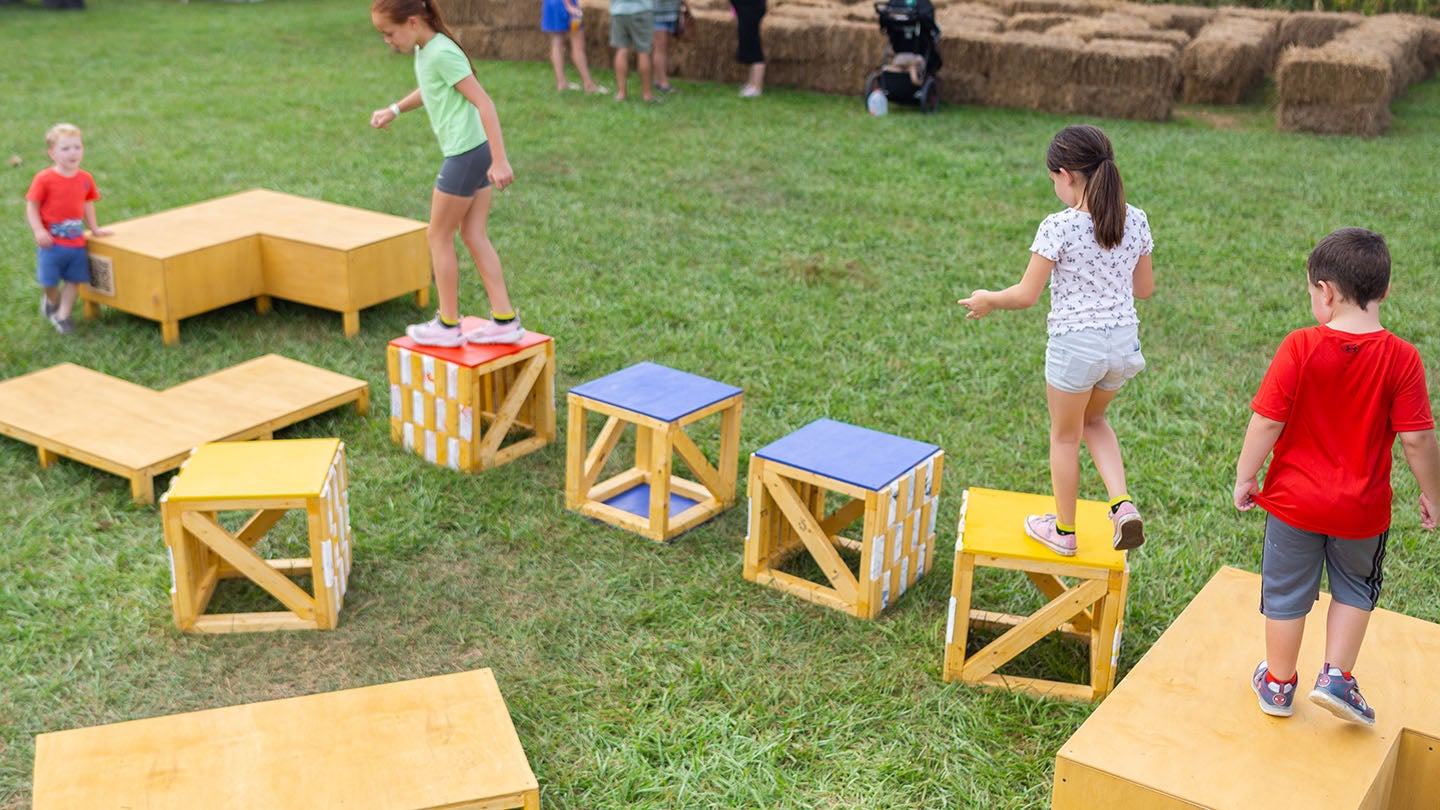
Project Description: Blocks is a modular furniture series designed to create an interactive and playful seating area for the Harvest Festival. Comprised of three components: an L-shaped bench, an L-shaped 6" step, and movable cubes, the project creates an engaging landscape that charges the user with defining its boundaries. The benches and steps are spread across the area to create different interaction zones, while the movable cubes can be stacked, moved, rotated, and shifted for individual needs. The movable cubes are clad on two sides with an alternating system of wood tiles and custom HDPE tiles. The HDPE tie-dye tiles are made from recycled HDPE plastic and cast in custom CNC-milled molds. This modular seating creates an engaging and versatile environment for all Harvest Festival visitors.
The Pen
Project Name: The Pen
Project Leaders: Kate Johnson (Faculty at Rochester Institute of Technology), Kelly Wilton (Faculty at Rochester Institute of Technology), Isabella Trindade (Faculty at Rochester Institute of Technology), Fabiano Sarra (Faculty at Rochester Institute of Technology).
Project Team: Parker Dubiel, Bennett Sarowitz, Kimberly Tana, Aiden Spicer, Courtney Lougheed, Janelle Teesedale, Luke Genter, Jaydon Thompson, Noah Gill, Julia Kress, Rachel How, Cynthia Wang, Leah Rosen (All student at Rochester Institute of Technology).
Project Description: The Pen is a 36-sided tridecahexagonal cylinder made from recycled materials, emerging from the ground as a multifaceted sculptural form. The structure serves as a submerged seating area, inviting engagement from visitors while visually aligning with a second adjacent 36-sided platform across the field. The distant deck functions as a stage, creating a dynamic interplay between the two elements. Together, these geometric forms redefine the landscape, offering a space for gathering, performance, and reflection, all within an environmentally conscious framework that reuses discarded materials.
PLEASE FORCE
Please Force: The Please Force—a reference to the 1969 Woodstock festival—served as organizers, build support, and general keepers of peace at Bethel Woods Art and Architecture Festival 2024: BuildFest.
Chief of Please: John Andrew Davis Hitch (AKA Wavy Davy).
Please Cadets: Cameron Kursel (AKA Baby Blue), Elizabeth Panic (AKA Daisy E), Taelor Parish-Williams (AKA NamasTae), James Grimm (AKA Jim-ga-lo-ba), Helen Bennett (AKA dj kiwi), Jacqueline Nguyen (AKA Hippie dippie Jackie), Varun Gandhi (AKA Guru), Claire Leffler (AKA The Big Deal), Riley Wines (AKA El Vikingo), Jacob Taro Gibbons (AKA Gibby Hendrix), Isaac Mendez (AKA Magic Ike).
2024 Curatorial Statement: BUILDings are, at their core, physical constructs. Even with the rise of computational design tools and digital fabrication, they are still, necessarily, grounded in the material world; for every robot that mills or prints an object, there are people who move and transport those objects. Likewise, FESTivals are physical interactions between people–one of the remaining few places where groups gather to interface and collaborate socially without a digital veil.
With this understanding, BuildFest approaches the dichotomy between the physical and digital not as a binary but as a chance for collaboration–asking participants to imagine what a future might look like in which digital and analog methods of construction are integrated in a more wholesome manner; one in which building technologies (old and new) can fuse to foster smaller, greener and more diverse economies capable of sustaining the long-term habitation of humans on this great floating mud-ball, planet earth.
 2024 Proposals:
Successful proposals focused on BUILDing, not as a noun but as a verb, and touched on one or more of the following thematic questions:
- How can digital and analog modes of design/fabrication better interface to create a more integrated construction ecosystem?
- How can computational tools, digital fabrication, and/or the use of off-the-shelf parts help supplement analog skills in the context of a four-day design-build camp?
- How can autonomous fabrication and/or robotics aid hand-building to push toward more ethical, smaller-scale economies of labor and construction?
- How can a site’s history and cultural significance inform and engage with built structure?
- What technologies should be rejected? How can labor be implemented as a meaningful activity rather than a necessary evil?
Likewise, proposals suggested the potential FESTivities that the respective artwork could facilitate, including:
- What function the installation serves?
- How the installation’s function can adapt over multiple festival seasons?
- What emergent activities of play and wonder can the installations facilitate in festival attendees?
- What new programmatic choreographies can the installation incite?
- How does the project interface with a decidedly physical setting?
- How does the project interface with a digital presence in its afterlife on the web and social media?